


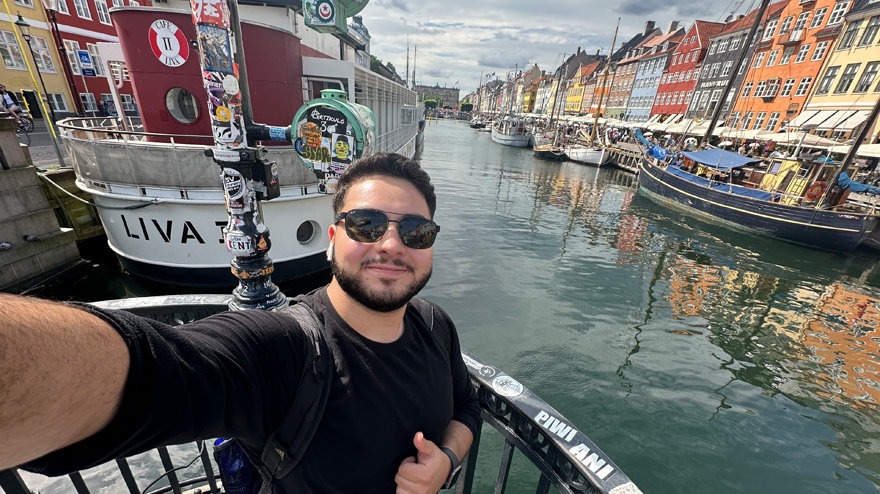
For LSUS public health student Ahmed Ghazawneh, access to prevention education regardless of language is a passion.
Ghazawneh was one of five students across the nation to read the National Mandate Against Sexual Assault on College Campuses as part of the 2026 National Campus Take Back the Night Virtual Rally in the first weekend of November.
He joined students from Yale, Loyola University of Chicago, Stanford and Cornell in the national reading.
“The experience was incredible, and what made it even more extraordinary for me was the fact that I was capable of doing something important that benefits the whole society,” Ghazawneh said. “The fact that I could use my voice to draw people’s attention to the issues of sexual assault and violence prevention was both privilege and responsibility.”
LSUS was one of 103 universities nationally to participate in the virtual rally, which brought together an incredible group of survivors, advocates and changemakers ranging from Broadway star Antuan Raimone, Take Back the Night Executive Director Katie Koestner, Assistant Director Amy Tilton, Olympic medalist Margaret Hoelzer, former NFL player Jon Vaughn, Weinstein survivor Rowena Chiu, Cosby whistleblower Stacey Pinkerton, and Anishinaabekwe survivor advocate Kateri Marion.
“Participating in national initiatives like Take Back the Night allows all LSUS students to be part of something much larger than our campus while reinforcing our commitment to preventing sexual violence and supporting survivors,” said Aslan Godfrey, director for LSUS’s program for the Campus Sexual Violence Elimination Act (SAVE). “Our participation sends a clear message that LSUS does not tolerate sexual violence and is committed to providing trauma-informed, survivor-centered services that prioritize individual autonomy, safety, and dignity.
“Ultimately, we want our students to know that their safety matters, their voices matter, and our commitment to ending sexual violence extends far beyond the boundaries of our campus.”
And not just English-speaking voices.
Ghazawneh translated materials into Arabic, including brochures, slide shows and videos directly impacting LSUS for use by the SAVE Program.
“Education and awareness should not depend solely on knowing the English language,” said Ghazawneh, who also serves as the vice president of the LSUS Student Government Association. “In fact, topics related to sexual assault, violence prevention, being safe should be discussed by everyone regardless of his/her cultural or linguistic background. In some communities, such issues may be very difficult to discuss openly, which is the reason why awareness must be spread even more.
“Being born and brought up in Palestine, and arriving back in the U.S. has made me realize the importance of being aware of how language and cultural gap can affect one’s access to knowledge and resources. Arabic is the language I identify my family and myself with, and using it to convey such an important message was very meaningful.”
Godfrey added that Ghazawneh’s translations provide cultural context that far surpass just a mere translation of English words to Arabic.
“Language should never be a barrier to accessing prevention education, resources, or support, especially when discussing something as sensitive and important as sexual violence,” Godfrey said. “Students need to see themselves, their languages, and their cultures reflected in the resources we provide.
“When students don’t see that representation, they may unintentionally feel that these conversations or services aren’t intended for them. Ahmed’s involvement helps us break down those barriers and reinforces a message we want every student to understand — regardless of your language, culture, or background, these resources are for you, your experiences matter, and you deserve access to support.”
Visit the program’s web page to learn more about the SAVE Program at LSUS.