


Staff Report/By Chris Gordon
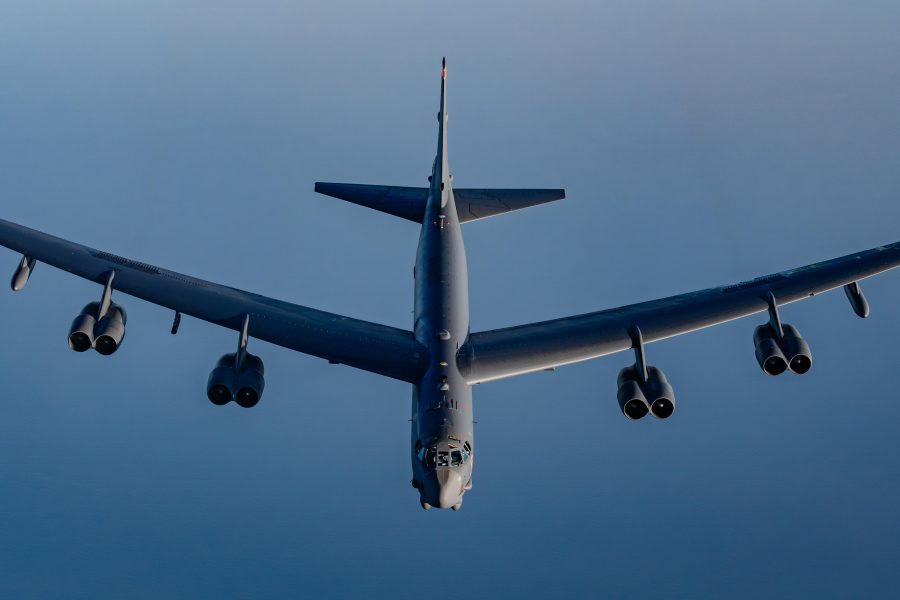
Three U.S. Air Force B-52 Stratofortress bombers flew off the coast of Venezuela Oct. 15 in a show of force, as the U.S. expands its military presence in the Caribbean.
The B-52s took off from Barksdale Air Force Base, La., and spent around two hours doing orbits in international airspace near Venezuela, according to U.S. officials and open-source flight tracking data.
The flights come as President Donald Trump has acknowledged that the CIA is conducting covert operations in Venezuela and the White House is considering attacks on Venezuelan territory.
Since Sept. 2, the U.S. has carried out five acknowledged airstrikes on what the Trump administration says are boats smuggling drugs in international waters. A sixth strike occurred Oct. 16, but for the first time, there were survivors in an incident first reported by Reuters. The last publicly announced strike on a boat was on Oct. 14, which Trump said was transporting “narcoterrorists.” All told, U.S. forces have killed at least 27 people since the campaign began.
“We are looking at land now, because we’ve got the sea very well under control,” Trump said Oct. 15.
The military operations are part of a broader pressure campaign on Venezuelan President Nicolas Maduro, whom the White House says is an illegitimate leader who should leave his post. Maduro has been charged in the United States for being involved in a conspiracy to smuggle cocaine and guns into the U.S., and the Trump administration is offering $50 million for information that leads to his arrest.
The legality of the lethal airstrikes on boats operated by non-state actors suspected of drug smuggling in international waters has been questioned by many legal experts as well as some U.S. lawmakers. The administration has yet to publicly provide any proof that the boats were carrying drugs. In the past, the U.S. Coast Guard, sometimes with the assistance of the Navy, has interdicted suspected drug boats.
The trio of B-52s that flew on Oct. 15 used the callsigns BUNNY01, BUNNY02, and BUNNY03. They had their transponders on, indicating that the U.S. military was not trying to hide their presence. U.S. officials also confirmed the mission to Air & Space Forces Magazine. B-52s have the capability to launch standoff missiles or drop JDAM bombs, though it is unclear if the B-52s were armed.
Air Force Global Strike Command directed questions to Air Forces Southern, which did not immediately respond to a request for comment. The Pentagon also did not immediately disclose the reason for the flight.
The U.S. has around 10,000 troops in the Caribbean, including Marines embarked on ships and a sizable amount of airpower.
As part of the buildup, the U.S. military has deployed 10 Marine Corps F-35Bs and at least six different Air Force MQ-9 Reaper drones in Puerto Rico. There are also AV-8 Harrier fighter jets embarked on the USS Iwo Jima, which has been operating in the region.
Airmen were photographed loading Hellfire missiles onto an MQ-9 on Oct. 15 at Rafael Hernandez Airport in Aguadilla, Puerto Rico, by the news agency Reuters. Images posted on social media on Oct. 14 show that at least one Air Force AC-130J that has been pictured in the U.S. terrority flying while armed with eight Hellfire missiles.