


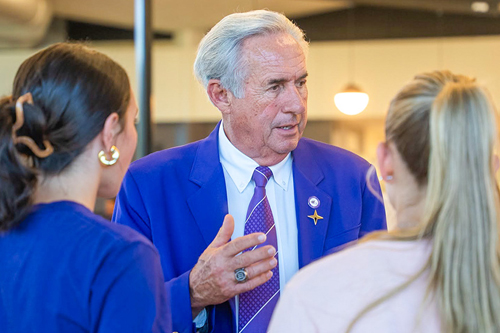
As James T. Genovese completes his second year as president of Northwestern State University, the institution is reporting gains in student persistence, academic outcomes, workforce-focused programs, private support and athletics while continuing to address enrollment and graduation challenges.
Since taking office in 2024, Genovese has organized the university’s work around five strategic focus areas: the student experience, academic excellence, market responsiveness, community enrichment and athletic prominence. University officials said those priorities have guided efforts in recruitment, retention, academic programming, capital projects, technology and external partnerships.
“Our first two years have been about strengthening the foundation of Northwestern while keeping our attention fixed on the future,” Genovese said. “We have made significant progress because our faculty, staff, students, alumni, donors and partners believe deeply in this University and in the role Northwestern plays in Louisiana.”
Student recruitment and retention have remained central to that work.
Overall enrollment declined from 8,523 in Fall 2024 to 8,402 in Fall 2025, but entering freshman enrollment increased to 1,065. Preliminary Fall 2026 figures provided by the university show approximately 1,120 entering freshmen, which will represent the university’s largest freshman class in three years when the official 14-day enrollment count is finalized.
The Fall 2026 entering class arrived with one of the strongest academic profiles in recent years, posting an average ACT score of 21.7 and an average high school GPA of 3.4. The class’s average ACT score is well above Louisiana’s average, reflecting the continued strength and academic quality of Northwestern’s incoming students.
Northwestern’s first-to-third semester retention rate reached 70 percent, exceeding the Louisiana average of approximately 64 percent and placing NSU among the strongest-performing institutions in the region. NSU has responded to retention and graduation challenges by strengthening early intervention, proactive financial-aid communication, academic mapping, stop-out recovery and support beyond the first year.
Student satisfaction provided another measure of progress. In the first year of Genovese’s presidency, 70 percent of students reported overall satisfaction, compared with 52 percent nationally, according to university survey data. Seventy-four percent said they intended to re-enroll, compared with 60 percent nationally.
The survey data showed gains in campus services, student-centeredness, registration and recruitment, financial aid, counseling, safety and campus conditions. Northwestern exceeded University of Louisiana System and national norms across most measures included in the survey.
Student involvement also increased. Membership in recognized student organizations grew from 823 to 1,292, while participation in living-learning communities increased from 68 to 168 students. The university also expanded or improved spaces supporting accessibility services, collegiate recovery and eSports.
Career preparation grew through Handshake, which connected a network of more than 30,000 students, alumni and employers. NSU approved 1,610 new employers during 2025-26. Among graduates responding to the university’s First Destination Survey, 93.3 percent reported employment, continued education or military service.
“Students should feel that Northwestern knows them, supports them and is preparing them for a meaningful life and career,” Genovese said. “The gains in satisfaction and persistence are encouraging, but we know our work must continue until more students who begin at Northwestern complete their degrees.”
Academic programs also expanded in areas tied to workforce demand.
The College of Nursing and School of Allied Health, which serves nearly 2,500 students across Alexandria, Leesville and Fort Polk, Natchitoches, Shreveport and online, added new nursing pathways and launched the Master of Science in Allied Health.
Allied Health enrollment increased 19 percent, from 412 to 491 students. Radiography enrollment rose from 100 to 182, while Diagnostic Medical Sonography increased from 86 to 115.
Student outcomes included nursing graduates exceeding state and national first-time NCLEX-RN pass rates, a 96 percent certification pass rate for Radiography graduates and 100 percent pass rates on the Sonography Principles and Instrumentation examination for the 2025 and 2026 Diagnostic Medical Sonography classes. Radiography also received the maximum eight-year accreditation term from the Joint Review Committee on Education in Radiologic Technology.
External awards are supporting additional healthcare education and workforce development. A $4 million Louisiana Department of Health award and a $2.597 million federal Health Resources and Services Administration award are supporting rural healthcare education, clinical training, student assistance and workforce expansion. More than $1.3 million in scholarships, stipends and traineeships assisted 239 students during 2025-26.
Other academic areas reported growth as well.
The Gallaspy College of Education and Human Development received nearly $8 million in grants during fiscal year 2025-26 supporting education, behavioral health, child welfare, early childhood development, workforce preparation and student success.
In the College of Arts and Sciences, new Computer Science and Sport Analytics concentrations within the Mathematics degree program helped increase Mathematics enrollment by more than 400 percent since 2024, according to university data. The college also engaged more than 5,600 K-12 students through School of STEM outreach events, camps, festivals and recruitment activities.
The College of Business and Technology expanded opportunities in applied technology, cybersecurity and workforce preparation. The School of Business received an extension of its accreditation from AACSB International, while Hospitality Management and Tourism maintained its status as Louisiana’s only four-year hospitality program accredited by the Accreditation Commission for Programs in Hospitality Administration.
The college also opened the Sandbox Application Development Lab and established the Cyber Demons Tech Club. A Computer Information Systems team competed for the first time in program history in the International Collegiate Programming Contest North America South Central Regional.
Across the university, 78.1 percent of academic programs have been created or updated within the past five years. NSU also offers 37 certificate programs in areas ranging from healthcare and education to strategic communication, leadership and professional ethics.
Programs launched or advanced during Genovese’s first two years include the Master of Social Work, Master of Science in Allied Health, new Mathematics concentrations, an online Master of Music in Music Education and redesigned pathways in nursing and criminal justice. The university also expanded options in event management, hospitality, cybersecurity, artificial intelligence and advanced manufacturing.
Industry engagement accompanied those academic changes. In 2025-26, students participated in 416 documented interactions with business and industry through career fairs, guest speakers, field experiences, interviews and service-learning projects. University administrators completed 56 additional engagements with industry partners.
Technology investments included creation of a continuously monitored Security Operations Center in partnership with the Louisiana Optical Network Infrastructure and other state agencies, increased internet capacity at the Alexandria and Leesville sites and modernization of the university’s network, data center and disaster-recovery systems.
Major facility investments also changed the learning environment. The $45 million Alost Hall opened with classrooms, laboratories, simulation spaces, a cafe and faculty offices. Iberville Dining Hall underwent a $2 million renovation, A.A. Fredericks Auditorium received improvements, and classrooms, laboratories and instructional technology were upgraded across campuses.
Eligible faculty and staff received a 3 percent cost-of-living adjustment on Jan. 1, 2026, following a 2.5 percent adjustment in January 2025.
State support in the 2026 legislative session included approximately $2.54 million in additional operating funding. Capital outlay legislation included $6.9 million in Priority 1 funding for Innovation Park and $7 million in Priority 1 funding for Warrington Hall in Shreveport.
Private support also increased. The NSU Foundation reported $8.04 million in fiscal year 2026 revenue, up 6.9 percent, while restricted endowment assets grew to $87.26 million university wide. Major gifts supported scholarships, professorships, academic programs and facilities, including a $1.5 million private gift supporting the David and Sherry Morgan Health Performance Center, which is scheduled to open on October 23.
Community engagement remained another focus. NSU reported at least 228,378 hours of professionally based service with 194 campus and community partners in 2025-26. That work supported healthcare, education, public safety, economic development, the arts and environmental stewardship.
Athletics posted gains in academics, competition and facilities.
Student-athletes maintained an overall GPA above 3.2 in both reporting years. In 2025-26, 211 earned Dean’s List or President’s List recognition, 216 were named to the Southland Conference Commissioner’s Honor Roll, and the department’s multiyear Academic Progress Rate rose for the third consecutive year to 970.
Seven teams earned perfect single-year Academic Progress Rate scores of 1,000. Women’s track and field won a third consecutive Southland Conference outdoor championship, soccer captured the conference regular-season championship, as did tennis, and six varsity teams finished in the upper third of the league.
Athletic facility improvements included approximately $1.9 million for artificial turf at the baseball and softball facilities, $593,000 in scoreboard upgrades and $1.7 million for a new track surface and lighting.
Looking ahead, Genovese said NSU will continue focusing on enrollment growth and degree completion, high-demand and flexible credentials, faculty investment, emerging technology, experiential learning, private support and partnerships. Work also will continue on Innovation Park, Warrington Hall and projects intended to support the student experience.
“These accomplishments belong to the entire Northwestern family,” Genovese said. “We have built momentum, but we are not finished. Our responsibility is to honor Northwestern’s history, respond to the needs of the present and prepare Louisiana for the future.”