


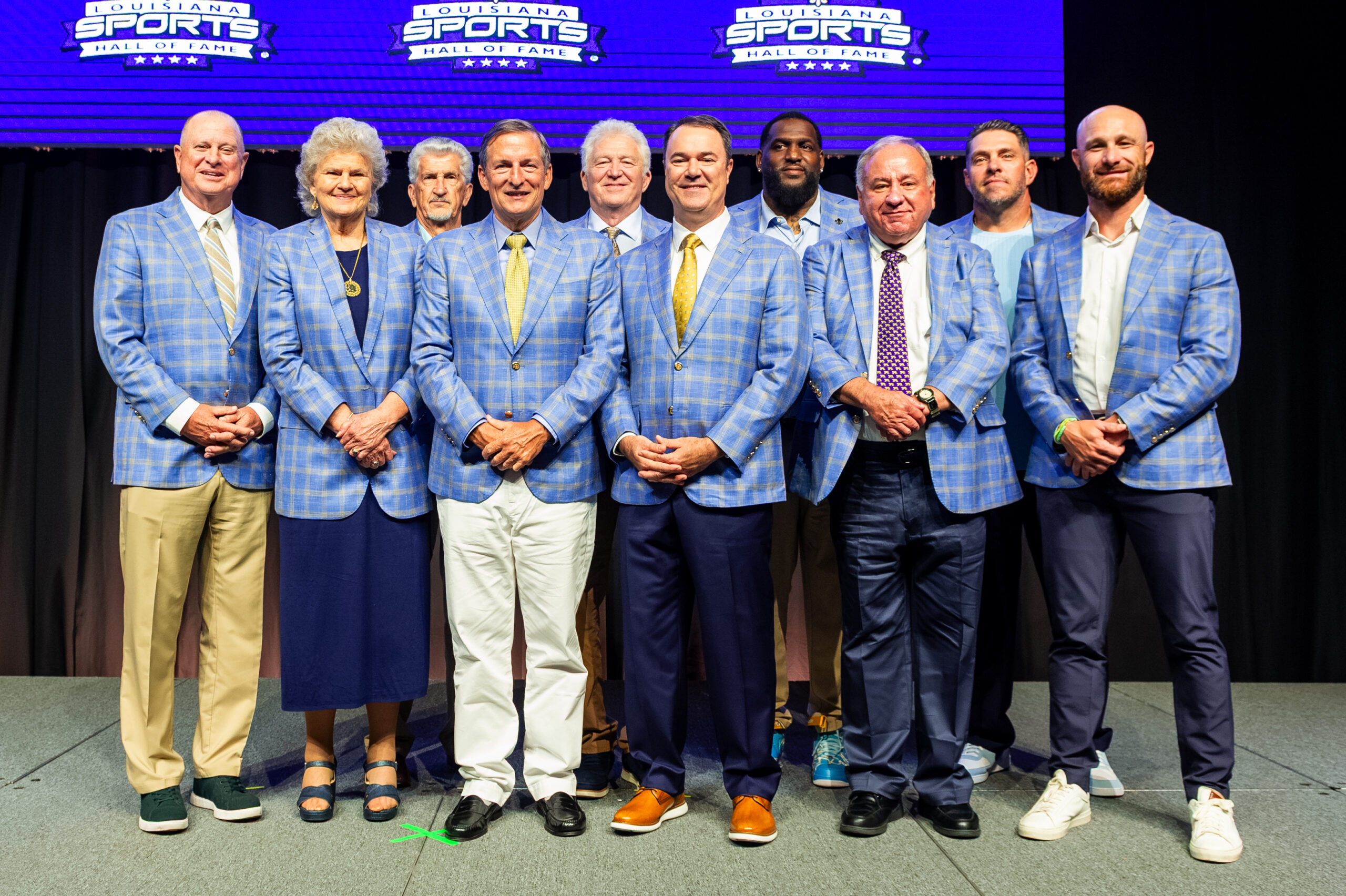
By Jason Pugh, Northwestern State Associate Athletic Director for External Relations; featured photo by Chris Reich, NSU Photographic Services
NATCHITOCHES – “When you build a house, you don’t build it from the roof down. You build it from the foundation up.”
With that little bit of “ol’ country boy common sense,” Dewain Strother, one of the nation’s leaders in all-time high school girls basketball coaching victories, summed up what he and the rest of Louisiana Sports Hall of Fame Class of 2026 espoused throughout Saturday night’s induction ceremonies inside the Natchitoches Events Center.
Strother was one of eight competitive-ballot inductees who were joined by a pair of Distinguished Service Awards in Journalism recipients, the Dave Dixon Louisiana Sports Leadership Award honoree and just the third Louisiana Sports Hall of Fame Ambassador Award electee in history who added their sterling resumes to the state’s shrine for its top athletes and sports journalists.
Strother’s remark regarding foundations was tied to the beginning of the Florien High School girls basketball team, which began play in the 1983-84 season with little fanfare and a grand total of four wins.
“That was about the time Title IX was hot for women’s sports,” Strother said. “They gave me the opportunity to start it. I knew I took on a big job, but I used some ol’ country boy common sense. There was a group in the eighth grade I was looking at, and I knew they could be a good team. We used some of the high schoolers to mold them. We won only four games that first year, and I thought, ‘I’m gonna get fired.’ The next year we were district champs.”
The step-by-step building process Stother instituted reached its zenith with a 48-0 state championship season in 1990-91 – the first of Strother’s six state championships at Florien, a Class B program that he built into a juggernaut. One year after that title, Florien started five players who would eventually play Division I basketball.
The success meant it wasn’t just basketball-obsessed Sabine Parish that took notice.
“I recruited a lot of them,” former Northwestern State women’s basketball coach James Smith said. “The kids were coachable and very fundamental.”
And successful. In addition to building the house that was Florien Black Cats girls basketball, Strother built something intangible.
“Being there for that long, you have a certain culture,” said St. Thomas More boys basketball coach Danny Broussard, himself a 2025 Louisiana Sports Hall of Fame inductee. “Kids that come in don’t want to be the team that lets them down and fail. That tradition means a lot.”
While Strother built a program that he led to 1,235 victories – the second most nationally among girls high school basketball coaches – former LSU men’s basketball coach John Brady had to rebuild a once-proud Tiger program while following legendary coach Dale Brown.
Brady came to Baton Rouge from Samford University, a mid-major program in Birmingham, Alabama, but the roots of his landing in Baton Rouge began decades earlier in Starkville, Mississippi, where Brady was a graduate assistant at Mississippi State.
“You go through life and you don’t know who you’ll meet and where they’ll show up later,” Brady said. “I went to Mississippi State as a GA and the other graduate assistant was Joe Dean Jr. We became great friends, and I’d go to Joe’s house and spend the weekend with the Dean family. (Joe Dean Sr.) was the guy who helped get guys jobs, made calls for them. I had to be successful for the opportunity for Joe (Sr.) to hire me. The relationship I made with Joe Dean Jr. led me to knowing his father. Twenty years later, I’m the head coach at LSU. It’s funny how life works and the twists and turns along the way.”
Following a Louisiana legend like Brown was not an easy transition, but Brady did it his way, relying on his basketball mantra to mold an LSU team on probation into an SEC championship team.
“John had a saying, ‘Responsibility plus accountability equals success,’” said Brady assistant Kermit Davis, who eventually became a head coach at Middle Tennessee and Ole Miss.
That equation – and the signing of Fair Park High School standout Stromile Swift – ignited a turnaround on the court and helped Brady truly start building a program that dealt with the loss of six scholarships across a three-year period.
Despite the sanctions, the foundation was in place for the building that would crest with a magical 2005-06 season where a group of six players from within a 50-mile radius helped Brady take the Tigers to the Final Four – a joyride that included an upset of top-ranked Duke and came just months after Hurricane Katrina ransacked the Louisiana Gulf Coast.
“That team, the top six players were from within 50 miles of Baton Rouge,” said Brady, who led the Tigers to a pair of SEC championships and three NCAA Tournament berths. “They had grown up playing with each other or against each other, and they had a really special bond. Every one of them was touched by the tragedy of Katrina, and I think that brought them even closer together.”
A similarly close bond between siblings helped deliver a signature moment for the LSU women’s basketball team when it landed Sylvia Fowles, a 6-foot-6 standout from Miami.
Brought to LSU by coach Sue Gunter, who promised Fowles nothing more than the opportunity to complete for playing time, Fowles teamed with fellow Louisiana Sports Hall of Famer Seimone Augustus to usher in the golden era of Tigers women’s basketball – one that included four straight Final Four appearances.
“In my home visit, (Gunter) told me she wasn’t starting me as a freshman, that I had to earn it,” said Fowles via a Zoom call from Chicago where her Portland Fire were preparing for a WNBA game against the Chicago Sky. “That motivated me to be around her. I was signed, sealed and delivered after hearing her say you had to work for everything you want.”
Fowles, who is now an assistant coach with the Fire, averaged a double-double at LSU before a prolific WNBA career with the Chicago Sky and Minnesota Lynx where she averaged 15.7 points and 9.8 rebounds per game in her career.
Four Olympic gold medals, two WNBA titles and a spot of the WNBA’s 25th Anniversary Team only buttress a resume that came in a sport Fowles once regarded as “dumb,” thanks in part to her three older brothers.
“Growing up with them, I was allowed to play defense only,” she said. “I didn’t learn the rules of the game until eighth grade. I didn’t there were two ends of the court playing simultaneously. It was that moment I realized I was getting cheated. I didn’t think the sport was dumb after that.”
Although her brothers failed to share the full extent of basketball with their younger sister, Fowles never missed an opportunity to help someone else.
“She’s the best center of all time in women’s basketball” said former Minnesota teammate Lindsey Whalen. “She had a relentless will to rebound and to get to her spot on the block. She had great hands. Then there were times you’d look over and she’s helping put towels away or doing anything she could to help someone else.”
Fowles did her share of scoring, but not quite to the point a young Kathy Holloway did at now-defunct Poland High School.
Holloway, the Dave Dixon Louisiana Sports Leadership Award winner, established a long-standing Class C state tournament record by scoring 86 points across two games while at Poland.
A lifelong love of basketball led Holloway to continue laying the foundation for that feeling of generations of basketball players in central Louisiana, first as a head coach at Tioga High School then as the first female president of the Louisiana High School Coaches Association, achieved in 1986, and as the president of the National High School Athletic Coaches Association in 1992.
“Title IX was passed in 1972,” said Julie Wilkerson, one of four high school All-Americans Holloway coached at Tioga. “That energized someone like Mrs. Holloway.”
That energy may have indirectly led Holloway to her trailblazing positions within the coaches associations she eventually chaired.
“In those days, there was All-Star Week and on the Friday before the all-star games on Saturday, there was the final meeting of the coaches association to elect the president,” Holloway said. “One of the guys who was running asked me at the barbecue, ‘Will you vote for me (for president)?’ I said, ‘Yeah, if you’ll vote for me if I ever run.’ He said, ‘There ain’t ever gonna be a woman president of this association.’ That sealed it for me.”
Following her gilded administrative career, the NSCA in 2021 created the Kathy Holloway Women of Inspiration Award that honors a female “that has promoted female athletics by either coaching, serving, supporting or leading high school female athletic programs that focus on changing lives and inspiring women to strive for greatness.”
Holloway remains involved in the sport she loves, working closely with the Upward Basketball program at First Baptist Church in Pineville where her son, Stewart, is the pastor.
“She’s been involved the past 13 or 14 years,” he said. “It’s a fantastic way to use her skills to invest in another generation.
“Mom didn’t win a lot of state championships, but she’s been a champion in a lot of other ways.”
As a quarterback at then-Jesuit High School in 1976, John James Marshall became a state champion, throwing the game-winning screen pass in the title game.
That trophy may have portended athletic greatness, but Marshall’s trophy case now overflows with innumerable awards from the Louisiana Sports Writers Association, an organization Marshall served as president of before his 30th birthday.
His writing prowess is just one of the tools in a multi-faceted toolbox that helped lead Marshall to the Distinguished Service Award in Sports Journalism.
“I couldn’t do anything else,” Marshall said. “I spent my whole being around sports. In baseball season, it was baseball. In football season, it was football. I just loved sports. Eventually, I kept loving sports when my friends were off becoming accountants and lawyers. I missed that train. This was a logical thing, keep doing sports. I can write about it. Everything in sports, what goes into players, coaches, the intricacies, everything involved in it fascinated me.”
In an appropriate iron sharpens iron moment, Marshall and 2022 DSA awardee Teddy Allen shared the 1987 Associated Press Sports Editors national best feature award.
“A guy like J.J. will make you work an hour longer, ready a little more copy, make another phone call because you know he’s going to be that good,” Allen said.
Marshall had plans on being a “40-year newspaper veteran,” but the industry had other ideas.
Marshall pivoted as deftly as a second baseman turning a 6-4-3 double play and teamed with his brother, Ben, to create “Sports Talk with J.J. and Ben” on Shreveport sports radio.
Thirty-four years later, the back-and-forth banter between brothers remains on the air as Louisiana’s longest-running sports talk radio show. Along the way, Marshall has served his alma mater, now Loyola College Prep, educating the next generation of journalists and becoming a part-time documentarian whose latest labor of love is a documentary about that 1976 state championship Jesuit squad, which Marshall hopes to unveil at the team’s 50th anniversary reunion in September.
“I was going to be a sports writer my entire life,” Marshall said. “In 1981, that’s what you thought. Those guys were 40-year veterans. I had to make a decision. When opportunity knocks, you answer the door. I didn’t know what it was going to lead to.”
A second opportunity came knocking for Marshall’s fellow 2026 DSA winner, Gil Lebreton.
Like Marshall, Lebreton’s career started before he earned his college degree.
Lebreton was working for the Times-Picayune part time in his hometown of New Orleans while attending LSU-New Orleans.
The schedule – and Lebreton’s affinity for sports – led him to drop a couple of classes, which made him eligible for the draft and landed him a one-year stint in Vietnam.
Once he returned from his military service, Lebreton had a plan and a career path in mind.
“When I came back, I used the G.I. bill and said, ‘Now, I can finally pay my way through LSU,” he said. “I was able to get a degree in journalism, and I was able to work for (legendary LSU sports information director) Paul Manasseh for three years.”
That experienced launched a 54-year career spent in New Orleans and Baton Rouge before Lebreton joined the Fort Worth Star-Telegram staff for the bulk of that time.
Lebreton’s resume includes Sports Writer of the Year awards for both Texas and Louisiana.
It also includes coverage of 16 Olympic Games – nine summer and seven winter – that were handled with the signature touch of a man whose opinions were rooted in belief and in the reflection of one of his early idols, the Times-Picayune’s Peter Finney.
“If you can give your opinion and back up what you’re saying – and if you’re fair, it works,” Lebreton said. “Most people appreciate that. I just watched the people I admired coming up. I watched Peter Finney and the gentleman he was. You don’t have to have a hot sports opinion and go for the throat. You get more done by listening and being kind.”
The respect Lebreton held for Finney has been returned in kind.
“Good or bad, Gil told the true and right story,” said former TCU head football coach Gary Patterson said. “He did it in a good way.”
Added Dan McDonald, a 2017 DSA winner: “It didn’t matter what the story was about or what sport it was about, if Gil’s name was at the top, I would read it.”
In much the same way, Lebreton’s writing was appointment reading, Joe Horn’s showmanship was part of the reason even casual fans were watching the New Orleans Saints at the turn of the century.
In six seasons with the Saints, Horn was a four-time Pro Bowler whose celebrations helped cement the wide receiver from Itawamba Community College in franchise lore.
“He will always be, for me, on the Saints’ Mt. Rushmore of receivers,” said Mike Detillier, a New Orleans sports talk host and NFL Draft scout. “When you needed him to make a big play – a first down or a touchdown – Joe was there, and he did it with flair.”
Horn, who was unable to make Saturday’s ceremony, hauled in 94 passes for 1,340 yards and eight touchdowns in 2000 as the Saints clinched their first NFC West championship. Across a five-year span from 2000-04, Horn averaged 87 catches, 1,259 yards and nine touchdowns across 79 games.
In the 2003 season, Horn delivered a moment forever memorialized on NFL highlight reels. Following a touchdown catch against the New York Giants, Horn retrieved a cell phone from underneath the goalpost padding, keeping a promise to his children.
The celebration cost him $30,000, but left him plenty of goodwill in the Crescent City.
“He showed what kind of guy he was and how flamboyant he could be,” said Jim Henderson, the longtime radio voice of the Saints.
Added Detillier: “He’s probably in the top five most popular Saints players ever. Frank Davis had this saying, ‘Naturally New Orleans.’ It’s about the culture here. Joe became the football version of Frank Davis. He was naturally New Orleans.”
Across from Horn during those NFC West – and eventually NFC South – battles was another member of the Class of 2026, Atlanta center Todd McClure.
A three-sport star at Central High School, McClure went to nearby LSU with designs on playing both football and baseball, where he would have teamed with his brother, Trey, an All-American on the diamond.
Instead, it took former Tiger coach Gerry DiNardo all of three games to nix any idea of Todd McClure joining his brother at venerable Alex Box Stadium.
“I had played mostly tight end and defensive end in high school,” McClure said. “I didn’t know how quickly I could pick it up. My sports background allowed me to pick it up so quickly. It helped to have Alan Faneca, an NFL Hall of Famer, teaching me the ropes. Coach DiNardo told me I had a chance to make the NFL. For a freshman, for him to put those thoughts in my mind, meant a lot.”
After a standout career anchoring the Tiger offensive line and twice earning All-SEC honors, McClure was a seventh-round draft pick of the Atlanta Falcons.
There, the man fellow Louisiana Sports Hall of Famer Kevin Faulk referred to as the second smartest player on that Tiger team and a true leader, McClure overcame a season-ending knee injury as a rookie to become even more than a foundation player for the Falcons.
“Todd was our rock of Gibraltar,” Falcons owner Arthur Blank said. “He’s one of the greats in the history of the Atlanta Falcons franchise. He’s an exceptional human being and leader in the NFL.”
A member of the Falcons’ Ring of Honor, McClure spent all 14 of his NFL seasons with the Falcons, a rarity in the current professional sports landscape.
“He dedicated himself not only to the team, but to his family,” said his father, Leo McClure. “He was able to keep them in one city. Sorry, Saints fans, once he was a Falcon, he was always a Falcon.”
McClure cited the meaning behind the Ring of Honor as the culmination of what he hoped for as a player.
“It wasn’t about awards or accolades,” he said. “You want to earn the respect of your teammates and coaches and the people you played against. For your owner to come out and show you that type of respect is why I played the game and why I loved the game.”
McClure and many offensive linemen during his career had plenty of respect for Monroe native Pat Williams.
Like Horn, Williams’ path from a standout career at Wossman High School to the NFL took him through the junior college route, beginning his college career at Navarro College in Corsicana, Texas.
After playing at Texas A&M and going undrafted, Williams grinded his way into the league and established a lengthy, often-dominant career at nose tackle, earning three Pro Bowl berths and a remarkable 37 game balls.
“I can’t say I was doubted,” Williams said. “I was doubting myself. I wasn’t doing school work like I should have been doing school work (in high school).”
Williams signed with the Buffalo Bills as an undrafted free agent in 1997 and enjoyed a standout eight-season run with the Bills, “tolerating” the blustery Buffalo winters.
In his lone foray into free agency, Williams signed with the Minnesota Vikings after the 2004 season. There he teamed with Kevin Williams (no relation) to form the dominant “Williams Wall” within the Vikings’ defensive line.
“He showed up and did some great things,” said Vikings defensive line coach Karl Dunbar. “Our first three years with Pat, we set an NFL record for holding teams under 63 yards on the ground. I saw the ability in Pat that he could really move around. He did that in college and in Buffalo. That’s how he earned the right to get to Minnesota.”
While Williams’ work went on in the trenches, one swing propelled Warren Morris into college baseball immortality.
Morris, an Alexandria native who played at Bolton High School before heading to LSU, delivered perhaps the most iconic moment in College World Series history when he launched a first-pitch curveball from Miami closer Robbie Morrison over the right-field wall at Rosenblatt Stadium in Omaha, Nebraska, for the first CWS-clinching, walk-off home run in history on June 8, 1996.
“Coach (Skip Bertman) used to tell us you can’t be afraid to fail,” Morris said. “Tim Lanier (who had struck out against Morrison the at-bat prior) looked at me and said three words, ‘Pick me up.’ As a team, those are the words you have to hear. No one’s always going to come through in the clutch or always be the guy. Someone else is there to pick you up. All I can do is the best I can do. I’m going to be aggressive. That’s why I hit the first pitch.”
Morris was honored with the Ambassador Award, joining national sports broadcaster Tim Brando and legendary Grambling baseball coach Wilbert Ellis as the only winners of that award.
“Warren embodies everything you want a citizen to be as far as work ethic, integrity and compassion,” legendary LSU baseball SID Bill Franques said.
Morris’ home run embodied what it meant to meet the moment.
While it ended on the highest of high notes, Morris’ 1996 season was interrupted by a hamate bone injury that limited him to 22 games – all of which resulted in LSU victories.
Morris enjoyed a nine-year professional baseball career following his LSU tenure. He finished third in the 1999 National League Rookie of the Year voting after hitting .288 with 15 home runs and 73 RBIs for Pittsburgh.
The son of a basketball coach, Morris collected baseball cards as a child. In his mind, all of those players hailed from major metropolitan areas. Today, Morris carries a few of his own cards when he speaks to children.
“No one from Alexandria at that time was at that level,” Morris said. “That was for someone else. I have some cards with me whenever I talk to kids know. I turn it around and show them Alexandria, Louisiana. If I can do something like that, there’s no reason they can’t achieve whatever it is their dream is.”
To cap the whirlwind following his home run, Morris – along with LSU coach Skip Bertman – was part of the 1996 U.S. Olympic baseball team, which won a bronze medal in the Atlanta Games.
“Just incredible,” Morris said of the Olympic experience. “It doesn’t get talked about enough. I still get goosebumps thinking about it, walking out on the field in Atlanta with 50,000 people chanting, ‘U-S-A.’ I’m as proud of representing my country as anything I ever did in athletics.”
Jonathan Lucroy is one of the few who truly can understand what Morris means.
A Florida native whose No. 21 jersey was retired this past spring at UL Lafayette, Lucroy was part of the gold-medal-winning Team USA squad in the 2017 World Baseball Classic.
“We’ve got rivalries everywhere,” Lucroy said. “There are rivalries in colleges. You have Astros-Rangers and Yankees-Red Sox. In my opinion, when you play under one umbrella, our country’s colors, it all goes away. Whenever you put your country’s name on your chest, the pride is hard to explain.”
What isn’t hard to explain is Lucroy’s induction into the Hall of Fame.
In three seasons with the Ragin’ Cajuns, Lucroy helped deliver two Sun Belt championships and a regional-final appearance. He did so by hitting .356, slugging .612 and setting school records for RBIs (184), doubles (54) and total bases (414).
Lucroy became a third-round pick of the Milwaukee Brewers where he teamed with fellow Louisiana Sports Hall of Famer Rickie Weeks and became a two-time All-Star, starting the 2014 Midsummer Classic.
Lucroy’s introductory video Saturday included the voice of his late college coach, 2022 Louisiana Sports Hall of Famer Tony Robichaux.
“You don’t have to be the man, just be a man,” Robichaux’s voice echoed.
“I’ve said this before, if it wasn’t for him, I wouldn’t have made it to the big leagues,” Lucroy said. “He was a great man of character. He had a couple of thousand people at his wake in Lafayette at the Cajundome. His funeral was packed out. It was insane. Having that kind of impact is huge. I hope I can have that effect one day.”
Lucroy’s effect on the teams he played on was clear.
He is a member of the Brewers Wall of Honor, having established several club records and the major league record for single-season doubles by a catcher (53 in 2014).
In a fashion befitting Robichaux’s constant preaching on work ethic, Lucroy became one of the game’s top defensive catchers – an area he admitted needed work when he came to the Cajuns, the lone Division I team to offer him a scholarship.
“Jonathan worked really hard to make sure he was a good catcher,” said Ron Roenicke, who managed Lucroy in Milwaukee. “He was a great man of character, a hard worker and a great teammate.”
While Lucroy’s work ethic made him a seamless fit on the field with the Cajuns, he fit in seamlessly in the state that honored him Saturday night in other ways.
“It’s a privilege,” Lucroy said. “I can’t even say any more than that – an honor and privilege. I’m a Florida kid, but I’m a redneck, so I fit in. I seamlessly integrated when I moved here. We were hunting and fishing. I was a natural. I married a Cajun girl. I’m very privileged to be a small part of it.”
While Lucroy felt to be a small part of his adopted state, few families have been tied to Louisiana basketball like the McConathys.
So when Mike McConathy, the state’s all-time record holder in college basketball victories, entered the Hall officially on Saturday, it felt like a win for the state of Louisiana – even if at the time he took over the Northwestern State program some thought McConathy had come from a planet far, far away.
“Mike McConathy stood up at his (hiring) press conference and talked about bringing Northwestern State basketball back to where it was when his dad and uncles played here,” said longtime NSU SID and Hall of Fame chairman Doug Ireland. “I thought, ‘This guy’s from Masr. You can’t do that here.’”
Not only could McConathy and his team do it, they did.
Two years after arriving in Natchitoches following a 16-year, 352-victory career at Bossier Parish Community College, McConathy’s 2000-01 Demon team was in the NCAA Tournament – a first for the program.
“I was fortunate to coach here and be able to be who I am,” McConathy said. “I do what I feel like I’m supposed to do to set an example. You do the little things. Don’t ask anyone to do what you wouldn’t do yourself. Those things are so important. If you impact your players and your staff around you, that allows you and your university to be seen in a different light.”
Never did that light shine as bright on Northwestern as it did March 17, 2006, when McConathy’s second NCAA Tournament entry stunned third-seeded Iowa on Jermaine Wallace’s last-second corner 3-pointer – a shot that still graces most March Madness intros during tournament season.
“Skip to the happy ending, but Mike was the perfect coach at the perfect time for Natchitoches and Northwestern State,” said former NSU Director of Athletics Greg Burke. “He just checked a lot of boxes. Sixteens seasons at BPCC at 22 wins per season. He told us he was going to recruit Louisiana. He did. The biggest shot (against Iowa) was made by a guy from Heflin.”
More than 20 years after the defining shot in NSU history, McConathy, whose father and two uncles played at Northwestern, can still vividly recall what led to Wallace’s moment in the spotlight.
“Ryan Edwards, whose dad was a doctor and an LSU graduate, was on our staff,” McConathy said. “Ryan rode to school in sixth grade with me to take (McConathy’s son) Michael into school with him because (Michael) didn’t like to go to school. (Greg) Brunner gets fouled and Ryan said, ‘Coach, we need to call timeout.’ I said, ‘OK, Ryan, we’ll do that.’
“We called timeout, we walked about what we were going to do. Brunner shoots the first and made it. We iced him. He missed (the second), Luke Rogers steps in, blocks out and rebounds. He looks up, passes and we go into our break. The ball goes to the right side and Kerwin Forges from New Orleans takes a pretty good shot with too much time on the clock to be honest. Jermaine Wallace is on the left side of the floor and did everything he’s supposed to do. He gets to the rebound spot he was supposed to go to. The ball falls to him, because he was where he was supposed to be.
“He had enough thought to look at the clock, see how much time he had and dribble to the corner and launch the winning shot.”
That was the most nationally relevant of McConathy’s 682 career on-court victories, but the 90 percent graduation rate of his players and their post-playing careers and lives brings as big a smile to his face.
The same can be said for the faith that drove McConathy to build the program at BPCC from scratch and then to take over a Demon program that had previously had just five winning seasons in its Division I history.
“Without the Lord Jesus Christ and our relationship with God, I wouldn’t have anything,” he said. “I’ve been given everything – an opportunity to be raised in a Christian home. They played it out for me to follow Christ or not. That’s so critical to do that. I had the opportunity to have a Christian wife and Christian boys and, hopefully, Christian grandchildren when they get to that point. If they do, that will be the greatest win ever.”