


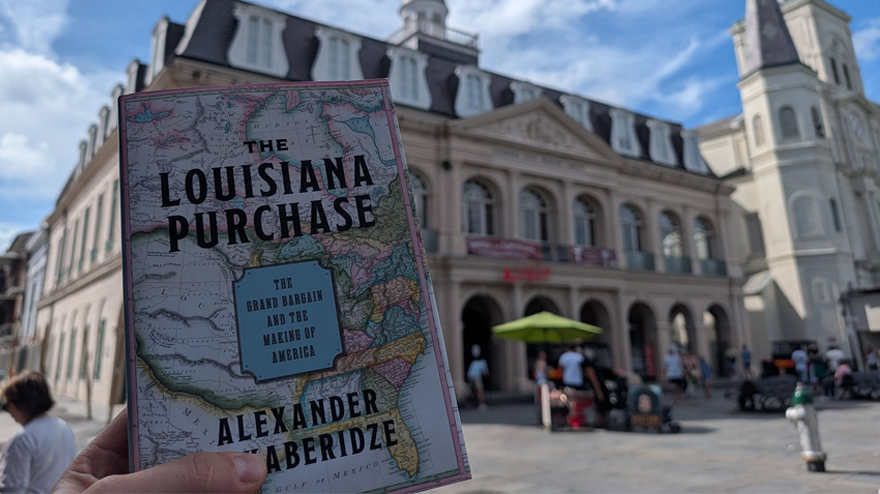
Many know the basics of the Louisiana Purchase – the historic land deal with France in 1803 that essentially doubled the size of the United States overnight.
The $15 million acquisition totaled nearly one million square miles of land that stretches from New Orleans across 15 present-day states and into Canada.
In a new book, LSU Shreveport history professor Dr. Alexander Mikaberidze seeks to deepen the reader’s understanding of the forces that precipitated this deal and its range of impact on various populations.
“The Louisiana Purchase: The Grand Bargain and the Making of America” will be published through Oxford University Press on July 3.
“I wanted to move beyond the familiar narrative of a great American land deal and place the Louisiana Purchase within the much larger story of French and Spanish colonial ambitions as well as the experiences of the Indigenous nations who called this land home,” Mikaberidze said. “My hope is to offer a more human, nuanced, and inclusive account – one that captures the complexity of the people, cultures, and empires that shaped Louisiana.
“The Louisiana Purchase is hardly an overlooked topic and has attracted generations of outstanding scholars who have documented a tremendous amount about the diplomacy, politics, and personalities involved. My goal was to build upon that scholarship by asking different questions.”
An internationally-renowned historian who has established a penchant for offering a global lens, Mikaberidze contextualizes the centuries of colonial acquisitions and ambitions of both France and Spain.
France and Spain competed for territory in the New World for parts of three centuries, shifting from open war to makeshift alliances to counteract a rising British empire.
“What interested me was stepping back and taking a look at the bigger picture,” said Mikaberidze, who became LSUS’s first-ever Boyd Professor in 2025, the highest professorial rank in the LSU System. “By the time Napoleon sold Louisiana, France had already spent generations trying to establish and maintain a successful continental empire in North America. Again and again, French ambitions ran up against enormous geographic distances, limited resources, Indigenous resistance, imperial rivalries, and the sheer difficulty of controlling such a vast territory.
“When you widen the lens, the Purchase looks less like a sudden American triumph and more like the culmination of generations of imperial ambitions, struggles, and – most crucially – failures.”
France didn’t “own” the vast majority of territory it “sold” to the United States. It merely forfeited its claim to the Americas as Napoleon’s focus shifted closer to home in preparation of an invasion of England that never fully materialized.
Mikaberidze’s work delves into how the Purchase impacted different groups of people, from French and Spanish citizens living in “Louisiana,” to various indigenous nations, to people of color (free and enslaved).
“The impact of the Purchase depended very much on who you were,” Mikaberidze said. “For many Americans, it represented opportunity – access to new land, economic possibilities, and the promise of westward expansion that fueled a sense of national optimism and helped transform the United States into a continental power.
“For the people living in Louisiana, the experience was often far more complicated. French and Spanish residents suddenly found themselves part of a new nation, forcing them to adapt to unfamiliar laws, political institutions, and cultural expectations.
“Free people of color enjoyed rights and social standing that were more extensive than those available elsewhere in the United States. Over time, the expansion of American rule strengthened racial hierarchies and contributed to the growth of plantation slavery. For enslaved people, the Purchase accelerated the spread of slavery into new territories and intensified the domestic slave trade.”
Mikaberidze added that the most profound consequences were felt by Native American nations.
“The vast majority of the land was still occupied, governed, and used by Indigenous peoples,” Mikaberidze said. “The Purchase marked the beginning of a new era of American expansion into those lands, leading to decades of treaty negotiations, land cessions, displacement, and conflict.
“In that sense, what many Americans celebrated as a diplomatic triumph often marked the start of tremendous upheaval for Native communities. One of the reasons I wrote this book was to remind readers that the Louisiana Purchase was not a single event experienced in the same way by everyone.”
Louisiana holds a personal place for Mikaberidze, who made the state his home when he joined the LSUS faculty in 2007.
“This book, in many ways is a tribute to Louisiana,” said Mikaberidze, a native of the country of Georgia who came to the United States as a graduate student, “Although I came to the state as an outsider, Louisiana welcomed me and became my home.
“Over the years, I developed a deep appreciation not only for its history, but also for its people, culture, and remarkable diversity. I wanted to tell the story of Louisiana in all of its complexity – not as a footnote to American expansion, but as a place that stood at the crossroads of empires, cultures, and peoples for centuries.”