


By Sheridan White, Kylah Babin and Izzy Wollfarth
LSU Manship School News Service
BATON ROUGE – As Louisiana lawmakers draw new congressional maps, one concern is how
the changes might affect the districts of U.S. House Speaker Mike Johnson and House Majority
Leader Steve Scalise and dilute Republican support in other areas, legislators said.
Prodded by President Donald Trump, national Republican leaders have urged lawmakers in
politically red states to create as many Republican districts as they can to try to maintain control
of the U.S. House.
After the Supreme Court struck down a Louisiana map with four Republicans and two
Democratic districts, the Republican-led state Legislature is facing pressure from some
conservative groups to draw new maps that could represent a clean 6-0 Republican sweep.
But some lawmakers, lobbyists and political consultants say that creating six Republican districts
could fan racial tensions and leave some districts with a small margin for error and the possibility
of Democratic upsets in future elections.
Reverting to a 5-1 map similar to what Louisiana had two years ago, they say, might enable
Republicans to create five districts that would be almost impossible for the Democrats to breach.
Under that scenario, lawmakers say, the Legislature also could create a majority-Black district
that stretches from New Orleans to Baton Rouge but tilts in favor of Baton Rouge, where Democratic U.S. Rep. Cleo Fields has sometimes been aligned with Republican Gov. Jeff Landry.
Rep. Gerald “Beau” Beaullieu, R-New Iberia, said in an interview Wednesday that he heard of
no pressure for a particular map from Washington.
“We will be intentionally trying to protect U.S. Speaker Mike Johnson,” he said, along with
Scalise.
Beaullieu said that in a 6-0 map that has been proposed by Sen. Jay Morris, R-West Monroe, the
percentages of likely Republican and Democratic voters would be close enough that at least two
districts might swing either Republican or Democratic.
The Senate and Governmental Affairs Committee is planning to hold a lengthy hearing Friday as
the first formal step toward creating the new districts.
Landry and legislative leaders have not specified what they favor. Landry said Tuesday that the
Legislature “should pass a map that is defensible. Defensible means that once we go to court,
that we will win, and we don’t have to go into this continuous legal vicious legal cycle that
we’ve been in.”
State Sen. Caleb Kleinpeter, R-Port Allen, who chairs the committee, told The Advocate that
some of Louisiana’s Republican congressmen “have serious concerns” about how easily they
could hold their districts if the most likely Republican voters were spread out more widely in a
bid to have six Republican districts.
“They might have issues running for reelection,” he said. “We can’t jeopardize the leadership in
Congress with changing maps.”
State Senate President Cameron Henry, R-Metairie, also told the paper: “A 6-0 map does not
guarantee six Republicans,” he said. “We’re working on the numbers.”
Minority leaders point out that nearly one-third of the state’s residents are Black, and they are
pushing for a continuation for the 4-2 split between Republicans and Democrats. But political
analysts see no chance of that happening after the Supreme Court ruled that race could not be a
major factor in creating the districts and nullified the current maps.
But if the Legislature decides to create a 6-0 map, there is a chance that two congressional
districts will have political competition, according to Peter Robins-Brown, executive director of
Louisiana Progress, a progressive advocacy group.
“If it’s, say, a blue year wave by any chance, then there’s a chance that two of the districts could
actually go Democrat,” Robins-Brown said. “You have enough Democratic voters in the state
that spreading them out among all six to the point where they wouldn’t have enough voting
power would be really hard to do.”
As Greg Rigamer, a political analyst, notes, the debate is less about mathematical fairness and
more about political priorities.
He argues that with a veto-proof Republican majority in the Legislature and a conservative
governor, the process will be driven by individual interests rather than a comprehensive plan for
the state.
Rigamer also suggests that Johnson and Scalise face no risk at all.
“They are absolutely safe, and the Legislature will do double backflips to protect them,” he said.
That dynamic is evident in comments from lawmakers like Rep. Jack McFarland, R-Jonesboro,
who emphasized that each legislator is focused on what their own constituents want.
“Every legislator is looking at it,” McFarland said. “What do their people want?”
McFarland also stated that he preferred his district to be a part of District 5, where it was in the
5-1 map, rather than District 4, where his voters currently reside. He reasoned that his voters
relate more to the other District 5 voters with their agricultural interests, going back to the idea
that districts have to have similar interests.
But the demographic numbers still tell an interesting story about how solidly Republican some
districts would be—or what types of tradeoffs would have to be made–under 5-1 or 6-0
scenarios.
Louisiana’s population stands at 4.6 million, with about 62.3% white and 32.6% Black residents.
That Black population, around 1.5 million people, accounts for approximately 30% of the voting-
age population, making its geographic distribution central to any redistricting effort.
Under the current map, Black voters are more heavily concentrated in two districts.
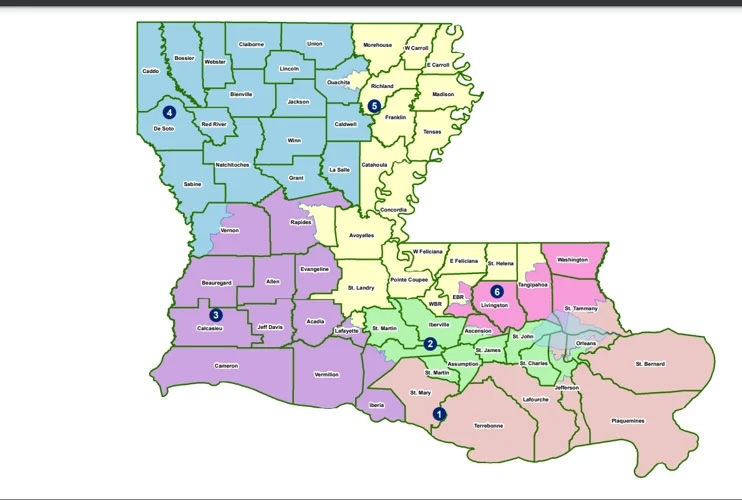
District 2, emanating from New Orleans represented by U.S. Rep. Troy Carter, now contains
about 365,000 Black residents, while District 6, under U.S. Rep. Cleo Fields, has about 394,000
Black residents as it snakes from Baton Rouge to Shreveport.
Together, these districts account for roughly half of the state’s Black population, leaving the
remaining four districts, held by Republicans, with significantly smaller shares.
Both Scalise and Johnson represent heavily white districts now. District 1 under Scalise, which
includes Jefferson Parish and coastal communities, has 561,000 white residents and 96,000
Black residents.
District 4 under Johnson, in northwest Louisiana, has 528,000 white residents and 161,000 Black
residents. Before the Legislature created the 4-2 map in early 2024, Johnson’s district included
259,000 Black residents. But the number dropped when the Shreveport area was added to what
became Rep. Fields’ district.
While Scalise and Johnson appear insulated, the same cannot be said for minority voters.
Concentrating Black voters into two districts ensured Democratic representation but limited
influence elsewhere. Conversely, dispersing those voters could increase Republican seats while
diluting voting power for minorities.
“The hardest thing has been for me to watch my colleagues, and some that I respect, I thought I
did—that I liked them— fight us so hard on having equal representation,” said Rep. Delisha
Boyd, D-New Orleans.
If lawmakers attempt to create six Republican districts, they might have to divide the Black
voters in New Orleans into two districts. Analysts said that to keep from placing too many Black
residents in Scalise’s district, the Legislature could mix parts of New Orleans in with St.
Tammany, Tangipahoa and Washington parishes to create a Republican-leaning district.
“I don’t think that would be impossible by any stretch of the imagination,” Robins-Brown said,
referring to the possibility of the Legislature splitting up New Orleans voters.
If Republicans were to push through a 6-0 map, another question would be how to dilute the
Black vote in Baton Rouge by mixing it into a district with a majority of suburban and small-
town whites.
If the Legislature created a 5-1 map instead, it could potentially shape a new district that
stretches from New Orleans to Baton Rouge, much like Rep. Carter’s does now.
Kleinpeter, the chairman of the Senate committee that is drawing the maps, told The Advocate
that he would favor tilting the voter base in any such district toward Baton Rouge since it has
gained population while New Orleans has lost it since Hurricane Katrina.
The current 4-2 map divides the Baton Rouge area into Fields’ district and the 5 th District. The
district, which reaches down from northeast Louisiana, is now represented by Republican U.S.
Rep. Julia Letlow, who is leaving to run for the U.S. Senate.
“I voted against the map the last time, and I voted against it because I thought that East Baton
Rouge Parish got carved up a little too much,” said Rep. Dixon McMakin, R-Baton Rouge. “And
so that’ll be something I will be looking at: How does East Baton Rouge fare in the new map,
being that we are the capital and the largest parish now in the state?”
Depending on what changes are made, the tradeoffs could be particularly visible in urban centers
like Orleans Parish, East Baton Rouge Parish and Caddo Parish, where large Black populations
anchor the state’s Democratic base, and have ripple effects elsewhere.
“I have heard from and seen a lot of Black folks in Louisiana speak to feeling like their voices
are diluted if not silenced when they live in ultra conservative districts, and so I would imagine
that same feeling and that same dynamic would carry over into a new map,” Robins-Brown said.
Scalise addressed the Louisiana House on Wednesday about economic development. But he did
not mention the redistricting issue.